
Medicare
Cost Cap committee considers who qualifies for increased primary care spending
In response to stakeholder feedback that the prior Cost Cap levels were unrealistic and risk unintended harm to patients, at their last meeting the Office of Health Strategy’s Cost Cap committee slightly softened the cap levels. The committee continued their discussion of which providers qualify as primary care providers. OHS wants to significantly increase the…
Read MoreCost cap project sets limits on healthcare spending without public input, ignoring pandemic impact
In meetings of the committee setting limits on healthcare spending for all Connecticut residents, it appears the advocates’ sign on letter and detailed concerns about the Office of Health Strategy’s (OHS’s) Cost Cap project were not heard. The plan is being developed by a Technical Advisory Team, with members chosen only by OHS, including some…
Read MoreFact Check: Do lower Medicaid provider payment rates cause higher commercial payment rates?

Download this Fact Check There’s a pervasive myth that lower Medicaid provider payment rates force providers to charge private insurers more to cover costs, but there is no evidence of that. On a simple level it makes some sense, but the truth is that providers, like most businesses, charge what they can, regardless of what…
Read MoreHelp for CT’s uninsured

With the recent spike in unemployment, many more Connecticut residents will be joining the thousands that were uninsured pre-COVID looking for healthcare coverage. The state has some new options to help. Check AccessHealthCT. You may be surprised to find that you qualify for HUSKY which is comprehensive, free, and includes most Connecticut providers. You may…
Read MoreCT hospitals would fare better than most if all payers used Medicare payment rates

A new study published in Health Affairs finds that if commercial payment rates were set at fee-for-service Medicare levels in 2017, US hospital revenue (inpatient and outpatient) would drop by 35%. Interestingly, also raising Medicaid rates to Medicare levels does little to mitigate that, changing the revenue loss to 30%. However, the authors note that…
Read MoreProtecting affordability in a pandemic — Experts find fair prices for remdesivir between $10 and $4,500

In a nation hungry for good news in fighting the COVID-19 pandemic, remdesivir has emerged as a first ray of hope. The FDA has quickly approved the drug for emergency use with seriously ill patients. However there are concerns that the data supporting remdesivir’s effectiveness has not been published or peer reviewed by independent scientists…
Read MoreCongressional move to rein in innovations that harm people, Connecticut advocates’ SIM concerns addressed in DC

A new bill in Congress, proposed by both Democrats and Republicans, would place controls on federal grants for payment and delivery reform projects. The Strengthening Innovation in Medicare and Medicaid Act was introduced last week to “increase transparency and accountability within the federal Center for Medicare and Medicaid Innovation (CMMI)”. CMMI is the federal agency…
Read MoreCT hospital quality still lacking
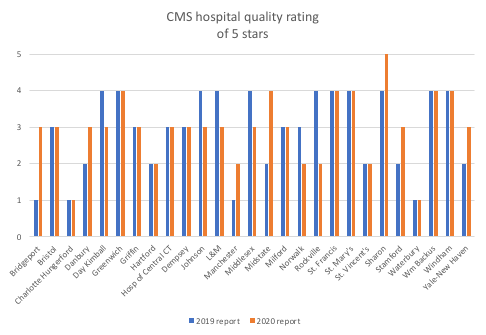
New Medicare hospital quality ratings find little change from last year’s report. Almost half of Connecticut hospitals received three stars out of five, about the same as last year. Quality ratings didn’t change for half of Connecticut hospitals. This confirms a long history of underperformance by Connecticut hospitals. We did have one five-star hospital (Sharon)…
Read MorePCMH (no Plus) program continues to grow and improve care

At MAPOC’s Care Management Committee meeting Wednesday, the state provided the latest numbers from the successful Person-Centered Medical Home program. PCMHs are primary care practices that coordinate care for patients, offer expanded hours, and address population health needs. The program continues to grow, adding 52 primary care providers and seven new sites of care in…
Read MoreSurvey finds CT ACOs planning services for high need members

Similar to national results, a new survey of Connecticut Accountable Care Organizations for MAPOC’s Complex Care Committee by the CT Health Policy Project finds that most are using multiple methods to identify high need members. But they are still working on implementing effective programs to address the needs. Many of their plans follow best practices…
Read More