
Stats & Data
CTNJ: Forecast Estimates More Than 100,000 New CT Medicaid Members
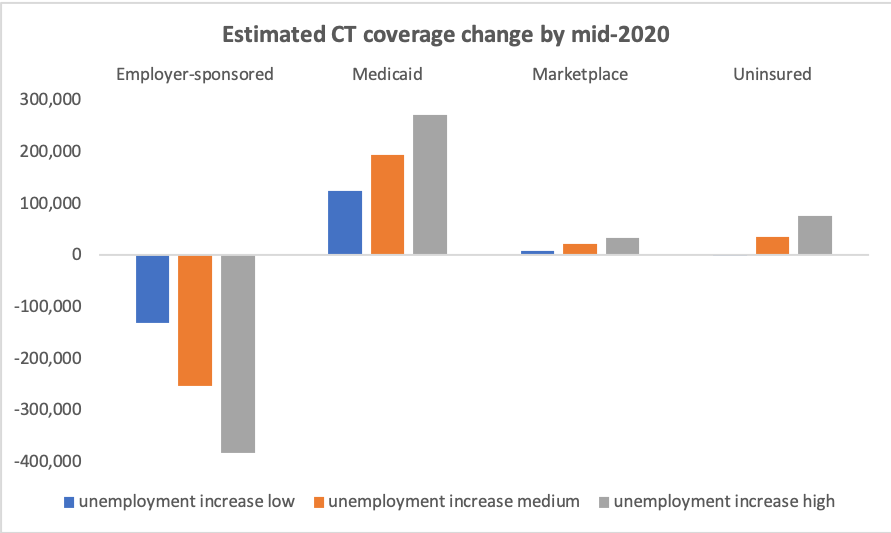
According to modeling by Health Management Associates, the COVID-19 pandemic could raise Connecticut’s Medicaid rolls 15% to 32% by mid-2020, depending on how much unemployment grows. Connecticut residents with employer-sponsored coverage could drop by 130,000 to 382,000 and Access Health CT coverage could grow by 8,000 to 33,000. Uninsured could rise by 77,000. Read more
Read MoreIs Connecticut ready for COVID-19?

Almost half (45%) of Connecticut adults have one or more clinical risks that could complicate COVID-19 infections, very close to the US average of 44%, according to a new report from the Commonwealth Fund. The report compares states across clinical risk factors of adults, state health system capacity, insurance coverage and other cost barriers to…
Read MoreCTNJ: The recession is here, and healthcare is in the center of it

After the longest economic recovery in US history, we’ve been expecting a recession for a long time. We knew when it came, Connecticut healthcare would be hit hard. But no one expected this. Connecticut didn’t fare well in the last recession and we took longer than other states to build back the jobs we lost.…
Read MoreMore HIE concerns from advocates and others

Public comment to the Office of Health Strategy about the state’s planned Health Information Exchange raised concerns, including those regarding privacy and selling/monetizing the data shared in the advocates letter. Connecticut’s three legal services agencies sent a letter with similar concerns on Friday. Advocates’ concerns were raised by members at last week’s online Health IT…
Read MoreWalletHub – CT third worst state for doctors

According to WalletHub’s latest rankings, Connecticut ranks 49th among states and DC for physician practice. Nationally, physician is the highest paying job but new doctors leave medical school with $194,000 in student debt on average. As we all may be relying on physicians and other healthcare providers during this crisis, remember that March 30th is…
Read MoreCommunity health center quality behind the rest of Medicaid

Download the report The good news is that Medicaid health outcome quality measures generally improved in all practice setting from 2016 through 2018. Unfortunately, community health centers (FQHCs) are not doing as well as their counterparts, either other Patient-Centered Medical Home practices (PCMHs), or non-PCMH practices in serving Medicaid members. This data comes from CHNCT’s…
Read MoreNew state health data updates – over one in six CT residents have high medical cost burden

According to State Health Compare’s updated data, 18.1% of Connecticut residents had out-of-pocket health costs that were more than 10% of their family income in 2018. That is up from 17.8% the year before while the burden on the rest of the US went down. While Connecticut’s rate is bad, it’s better than the US…
Read MoreICER and Donaghue Foundation highlight the power of patient engagement in assessing value; ICER to report on novel opioid addiction interventions

Steve Pearson, President of the Institute for Clinical and Economic Review (ICER), has published two pieces for Connecticut’s Donaghue Foundation Soapbox on the importance of meaningful patient engagement in value assessments and an exciting new initiative to move beyond the usual rhetoric and integrate patient priorities into the value assessment outcomes. Patients are usually left…
Read MoreMedicaid switch from MCOs saving taxpayers billions

Download the brief here If Medicaid per member per month costs had held steady at 2012 levels, taxpayers would have spent $2.25 billion more by last year. As with most health care in Connecticut, Medicaid spending was rising quickly before 2012 growing by almost half over the prior four years. But in 2012, Connecticut made…
Read MoreIs CT healthy or not? Different rankings with different messages

Health rankings are all about definitions and what you measure — an important lesson with broad implications. A new health ranking of US cities by Wallet Hub is not great news for Connecticut. Of America’s 174 most populous cities, Bridgeport is #88 and New Haven is #98. Five cities in surrounding states are healthier than…
Read More