CT Health Reform
Cost Cap committee considers who qualifies for increased primary care spending
In response to stakeholder feedback that the prior Cost Cap levels were unrealistic and risk unintended harm to patients, at their last meeting the Office of Health Strategy’s Cost Cap committee slightly softened the cap levels. The committee continued their discussion of which providers qualify as primary care providers. OHS wants to significantly increase the…
Read MoreUpdate: OHS committee slightly eases unrealistic cap for CT healthcare costs

In response to stakeholder concerns, at their July 29th meeting the Office of Health Strategy’s (OHS) Technical Team choosing the cap for future Connecticut healthcare costs eased their previous decision on how much healthcare costs for every state resident will be allowed to increase over the next five years. Many stakeholders have voiced concerns that…
Read MoreComprehensive updated resource on Connecticut’s health landscape from DPH, get involved

Almost one in six Connecticut children are food insecure and the number of state residents newly diagnosed with HIV has been dropping since 2010, according to the Dept. of Public Health’s new 2019 State Health Assessment. In 2017, 14.4% of Connecticut high school students used e-cigarettes, up from 2.4% in 2009. Over one in four…
Read MoreCost cap update – possible easing on growth cap but primary care target proves difficult
In response to concerns from many sources about potential harm to people, the Office of Health Strategy (OHS) is considering easing the proposed caps on the growth of all healthcare spending. In the latest Technical Team meeting, OHS and Bailit, the consultants running the project, said they would consider starting the cap next year higher…
Read MoreStudy finds PCMHs cost less, fewer ED visits than ACOs
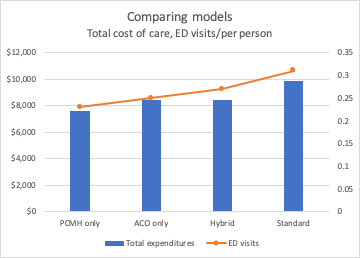
A new analysis finds that total healthcare costs and ED visits are significantly lower for adult patients of Patient-Centered Medical Homes (PCMHs) than for Accountable Care Organizations (ACOs), hybrids (both PCMHs and ACOs), or standard care (from facilities that are neither). PCMH patients had the lowest average total cost of care, 23% lower than standard…
Read MoreFact Check: Are primary care doctors underpaid?
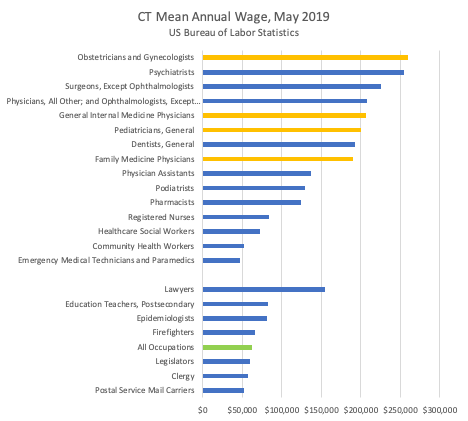
Download the Fact Check A statement was made in a recent Connecticut state public meeting that primary care physicians are paid less than specialists. The statement was made a recent Technical Team meeting for the Office of Health Strategy’s cost cap project considering a substantial increase in spending on primary care. The facts, however, are…
Read MoreImprove health policymaking — Nominate a claim for fact checking

In Connecticut state policymaking committee meetings, advocates routinely hear questionable claims stated as facts. Often very important caveats and context are left out. As non-members, we have no opportunity to question the claim or correct the misinformation. Too often policy is made based on these un-challenged claims. For twenty years, the CT Health Policy Project…
Read MoreCTNJ: For a better post-COVID policy process, CT needs to abolish all committees

I couldn’t agree more with my advocacy friends who called on the legislature to open public hearings to online participation. But legislative hearings are only part of the problem. Connecticut policymakers need to abolish all taskforces, boards, workgroups, design groups, consortia, advisory and steering committees, teams, councils, and similar committees. These insular groups, run with…
Read MoreCost cap project sets limits on healthcare spending without public input, ignoring pandemic impact
In meetings of the committee setting limits on healthcare spending for all Connecticut residents, it appears the advocates’ sign on letter and detailed concerns about the Office of Health Strategy’s (OHS’s) Cost Cap project were not heard. The plan is being developed by a Technical Advisory Team, with members chosen only by OHS, including some…
Read MoreOHS committee chooses unrealistic cap for CT healthcare costs

The Office of Health Strategy’s (OHS) Technical Team choosing the cap for future Connecticut healthcare costs has decided on a 3.1% allowed increase for next year, dropping over time to 2.7% by 2025. To illustrate the impact of the cost cap, consider the significant variability in Connecticut’s per capita all-payer total healthcare cost increases from…
Read More