HUSKY
Advocates, providers send Governor, legislators letter about cost cap impact and unintended consequences

Yesterday, twenty advocates and providers sent letters to the Governor and legislative leaders objecting to the rush to develop a cap on healthcare cost increases during a pandemic, and to use the time to incorporate input from diverse stakeholders and for thoughtful design with a broad group chosen democratically. “This controversial proposal, if rushed ahead…
Read MoreCT hospitals would fare better than most if all payers used Medicare payment rates

A new study published in Health Affairs finds that if commercial payment rates were set at fee-for-service Medicare levels in 2017, US hospital revenue (inpatient and outpatient) would drop by 35%. Interestingly, also raising Medicaid rates to Medicare levels does little to mitigate that, changing the revenue loss to 30%. However, the authors note that…
Read MoreProtecting affordability in a pandemic — Experts find fair prices for remdesivir between $10 and $4,500

In a nation hungry for good news in fighting the COVID-19 pandemic, remdesivir has emerged as a first ray of hope. The FDA has quickly approved the drug for emergency use with seriously ill patients. However there are concerns that the data supporting remdesivir’s effectiveness has not been published or peer reviewed by independent scientists…
Read MoreCTNJ: Forecast Estimates More Than 100,000 New CT Medicaid Members
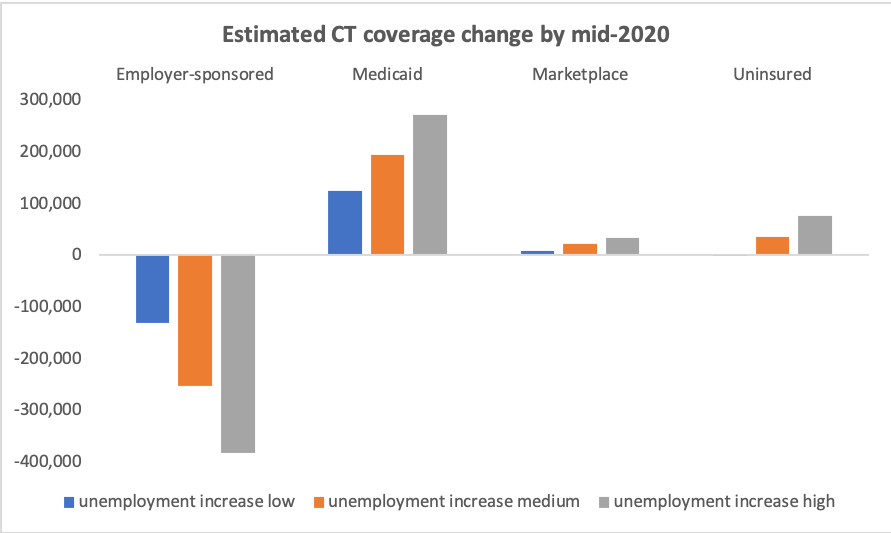
According to modeling by Health Management Associates, the COVID-19 pandemic could raise Connecticut’s Medicaid rolls 15% to 32% by mid-2020, depending on how much unemployment grows. Connecticut residents with employer-sponsored coverage could drop by 130,000 to 382,000 and Access Health CT coverage could grow by 8,000 to 33,000. Uninsured could rise by 77,000. Read more
Read MoreCTNJ: Analysis — Will COVID-19 Make Health Insurance Premiums Skyrocket?

Not necessarily. COVID-19 could cost the US between $34 billion and $251 billion for testing, treatment and care. Some analysts have predicted that premiums will rise between 4% and 40% next year because of the pandemic. Because consumers, taxpayers and workers ultimately pay the bills, from our taxes, our lost wages, our premiums, and directly…
Read MoreLetter urges state to go farther to protect Connecticut’s health and affordability

Building on previous letters from legal services, the CT Health Policy Project sent a letter today thanking the state for important protections adopted to protect Connecticut’s health during the pandemic. We also urged the state to adopt new policies and expand some already adopted. Require insurers to automatically continue providing commercial insurance during the crisis…
Read MoreCTNJ: The recession is here, and healthcare is in the center of it
After the longest economic recovery in US history, we’ve been expecting a recession for a long time. We knew when it came, Connecticut healthcare would be hit hard. But no one expected this. Connecticut didn’t fare well in the last recession and we took longer than other states to build back the jobs we lost.…
Read MoreCommunity health center quality behind the rest of Medicaid

Download the report The good news is that Medicaid health outcome quality measures generally improved in all practice setting from 2016 through 2018. Unfortunately, community health centers (FQHCs) are not doing as well as their counterparts, either other Patient-Centered Medical Home practices (PCMHs), or non-PCMH practices in serving Medicaid members. This data comes from CHNCT’s…
Read MoreMedicaid switch from MCOs saving taxpayers billions

Download the brief here If Medicaid per member per month costs had held steady at 2012 levels, taxpayers would have spent $2.25 billion more by last year. As with most health care in Connecticut, Medicaid spending was rising quickly before 2012 growing by almost half over the prior four years. But in 2012, Connecticut made…
Read MoreEvidence that children with private or Medicaid coverage both at risk of low-value care

A new study finds that both Medicaid and privately insured children frequently receive healthcare services that do not improve health. There has been an assumption that because providers are paid less by Medicaid, they have no incentive to provide unnecessary services. The study, published in Pediatrics, analyzed records from almost 7 million American children in…
Read More