CT Health Reform
Five healthcare issues to follow in 2020
What Connecticut can do in an election year, with a tight budget, in an unsettled economy, and Washington in gridlock Download the details ACOs and provider financial risk Accountable Care Organizations (ACOs) are large and growing systems that touch every aspect of healthcare. They make money by reducing their patients’ care costs. Unlike insurers, ACOs…
Read MoreCT now fourth healthiest state

Connecticut residents are healthier than all but three other states. According to the latest America’s Health Rankings by the United Health Foundation. That is down from third last year, and below 2006 and 2008 when we were the healthiest in the nation. Despite the wobbling, we consistently rank well. Unfortunately, our health isn’t reflected in…
Read MoreCT employee insurance costs up, but total picture is more complicated

Worker costs for health insurance are growing in all states, including Connecticut, both in total dollars and as a proportion of median incomes, according to a new analysis by the Commonwealth Fund. Connecticut has not been hit as hard as other states, because in the past growth in median income here was strong. But that…
Read MoreSurvey finds CT ACOs planning services for high need members

Similar to national results, a new survey of Connecticut Accountable Care Organizations for MAPOC’s Complex Care Committee by the CT Health Policy Project finds that most are using multiple methods to identify high need members. But they are still working on implementing effective programs to address the needs. Many of their plans follow best practices…
Read MoreHealthcare workforce growing faster than rest of employment

In good news for healthcare workers, from September 2018 to 2019, Connecticut healthcare employment grew by 1.75%, or 3.8 times faster than total non-farm employment. One in eight Connecticut workers is employed in healthcare. Healthcare grew even faster nationally, by 2.66% vs. 1.50% for all workers. One in six US workers is employed in healthcare.…
Read MoreBipartisan Insurance Committee forum finds a lot of consensus on potential reforms

Download the CTHPP presentation Yesterday the Chairs and Ranking Members of the Insurance Committee convened a forum on potential reforms to lower healthcare costs. Legislators invited David Seltz from the Massachusetts Health Policy Commission. Connecticut speakers included representatives from the insurance industry, providers, state officials, a foundation and advocates. A recurring theme was the need…
Read MoreCTNJ: CT’s uninsured rate is down and stable, so who’s still uninsured?

According to the latest numbers from the US Census, 187,000 Connecticut residents or one in twenty of us, were uninsured last year. That’s both good and bad news. Read more
Read MoreConnecticut’s uninsured rate stabilizes, retaining ACA gains

Download the report New numbers from the US Census Bureau report that 187,000 or 5.3% of Connecticut residents were uninsured last year. That number is down slightly from the year before when the uninsured rate was 5.5%, but above 2016’s rate at 4.9%. The new data continues the trend of fewer uninsured that began with…
Read MoreCT Medicaid child checkup rates jumped when HMOs were fired
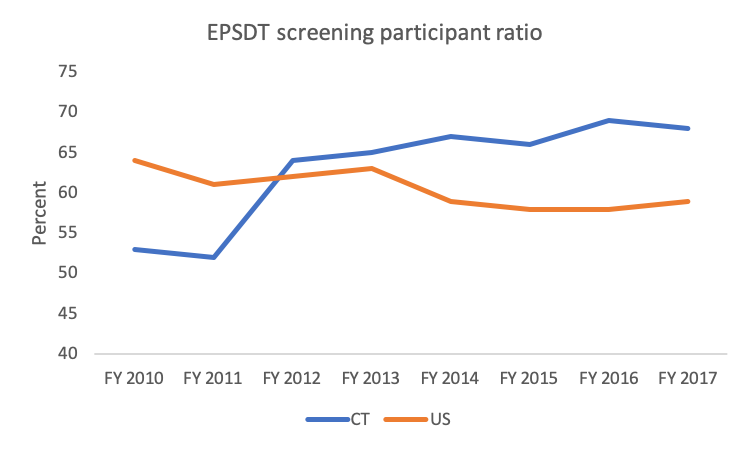
Well-child screenings increased twelve percent for HUSKY children between FY 2001 and FY 2012, according to a new report from the Government Accounting Office. While correlation is not causation, it is important to note that on January 1, 2012 Connecticut Medicaid payment shifted from capitation through private managed care companies to our current managed fee-for-service…
Read MoreCTNJ: CT Medicaid is making the same mistake, again
Despite warnings, the state is about to make a big mistake, again. DSS is planning to renew PCMH Plus, their risky Medicaid experiment that has cost the state more and done nothing to improve care, jeopardizing hard-earned progress. Two years ago, when the state wanted to expand PCMH Plus the first time, advocates raised alarms…
Read More